
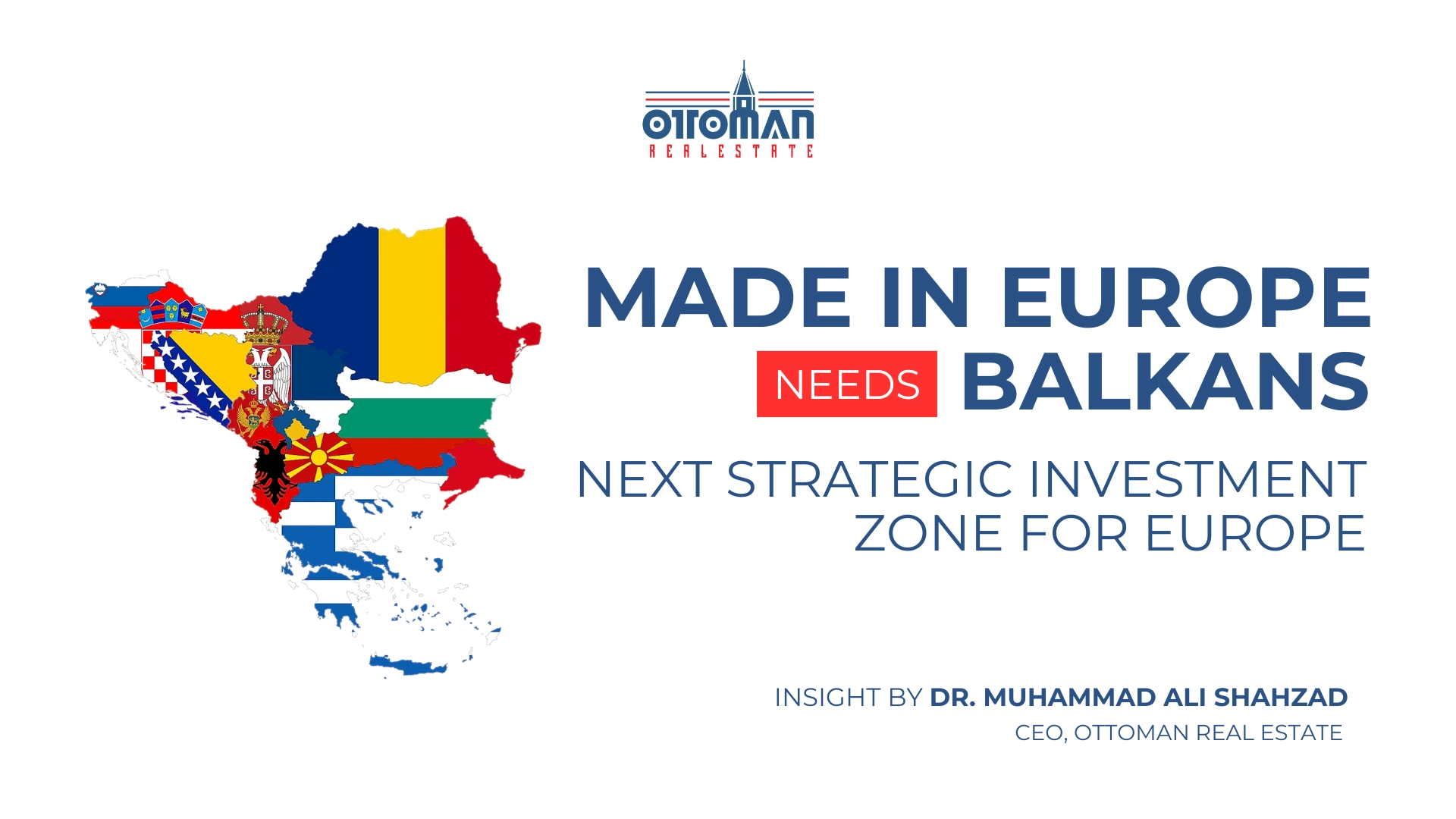
As the European Union considers strengthening “Made-in-Europe” content rules for strategic industries, most of the debate has focused on Western and Central Europe. Yet an overlooked region may hold some of the smartest answers to Europe’s competitiveness challenge: the Balkans.
If Europe truly intends to build resilient, efficient, and affordable supply chains within its borders, the Balkan states deserve significantly more attention from policymakers, manufacturers, and global investors.
These countries offer something rare in the European landscape:
the geography of Europe, the political alignment with European institutions, and the cost competitiveness that traditional EU markets can no longer sustain.
The result is a region uniquely positioned to become Europe’s next major industrial and investment corridor.
The Balkans: Europe’s Cost-Effective Production Belt
Across the EU, manufacturers are experiencing a structural shift. They are under pressure to:
- Move more production inside Europe
- Maintain price competitiveness
- Reduce reliance on long, risky supply chains
But Western European industrial hubs are facing rising labor prices, higher real estate costs, and tightening regulatory burdens. This is where the Balkans create a compelling alternative.
Countries such as Serbia, North Macedonia, Albania, Bosnia and Herzegovina, Montenegro, and Kosovo, alongside EU members like Croatia, Bulgaria, Romania, Slovenia, and Greece, offer:
Lower labor costs compared to Western Europe, but with increasingly skilled and educated workforces
Competitive real estate prices for manufacturing facilities, logistics hubs, and industrial parks
Young populations eager to integrate into European and global value chains
For companies that must comply with emerging “Made-in-Europe” requirements without sacrificing profitability, the Balkans function as a cost-efficient production belt inside or directly adjacent to the EU framework.
A Strategic Location Between the EU, Turkey, and Global Markets
Few regions in the world offer the geographic advantage of the Balkans. They sit at the crossroads of Western Europe, Eastern Europe, and Turkey, giving investors immediate access to multiple consumer and production markets.
Key advantages include:
- Proximity to major EU markets, reducing logistics risks and transport timelines
- Connections to the Adriatic, Aegean, and Black Sea ports, expanding trade routes
- Road and rail corridors linking Central Europe, Turkey, and the Middle East
For companies currently investing in or sourcing from Turkey, the Balkans complement these strategies perfectly by providing additional “inside Europe” production or distribution nodes.
As global firms implement near-shoring and friend-shoring strategies, the Balkans become a natural choice for industries such as:
- Automotive and machinery
- Construction materials
- Light manufacturing
- IT and outsourcing
- Renewable energy technologies
This strategic positioning transforms the region from an overlooked periphery into a central link in Europe’s evolving supply chain strategy.
Real Estate and Infrastructure: From Undervalued to Strategic
The shift toward European-based supply chains will not only influence factories. It will also reshape real estate demand and valuations across the region.
At present:
- Industrial parks, warehousing, and logistics zones in Balkan capitals and secondary cities remain undervalued compared to Western Europe
- Public and private investments in transport, energy, and digital infrastructure are improving connectivity every year
- Significant opportunities exist for public–private partnerships (PPPs) in logistics, energy, and urban development
As large manufacturers and distributors expand into the Balkans, well-located properties are expected to appreciate significantly.
For forward-looking investors, this is a moment to enter the market before Balkan industrial zones become fully priced as core European assets.
Human Capital and Alignment with EU Standards
One of the region’s greatest strengths is its trajectory toward EU regulatory, institutional, and economic alignment.
Many Balkan states are:
- Harmonizing their regulations with EU standards
- Improving ESG compliance
- Strengthening rule of law and governance frameworks
- Integrating into European quality and labor norms
Universities and vocational institutes across major cities are producing a pipeline of engineers, IT professionals, skilled technicians, finance graduates, and managers who can support more complex, higher-value production.
As institutional quality rises, country risk premiums decline, increasing the likelihood of capital gains for early investors.
The Balkans are no longer simply low-cost.
They are converging with European standards, which makes them highly compatible with the next phase of Europe’s industrial strategy.
A Call to Rethink Europe’s Industrial Map
If Europe is serious about reinforcing industrial resilience while remaining globally competitive, the Balkans must be treated as a central part of the solution.
For policymakers, this means investing in:
- Better transport corridors
- Harmonized regulatory frameworks
- Deeper integration of Balkan economies into EU supply chains
For investors, it means expanding the map of opportunity beyond traditional Western hubs and recognizing the Balkans as:
- European in identity
- Competitive in cost
- Strategic in location
In the emerging era of “Made-in-Europe,” the Balkans stand out as one of Europe’s smartest answers to the dual challenges of resilience and affordability.
Insight by Dr. Muhammad Ali Shahzad
CEO, Ottoman Real Estate