Global energy risks are rising as supply routes face uncertainty. Explore how the Arabian Energy Corridor offers a practical regional solution for energy security.
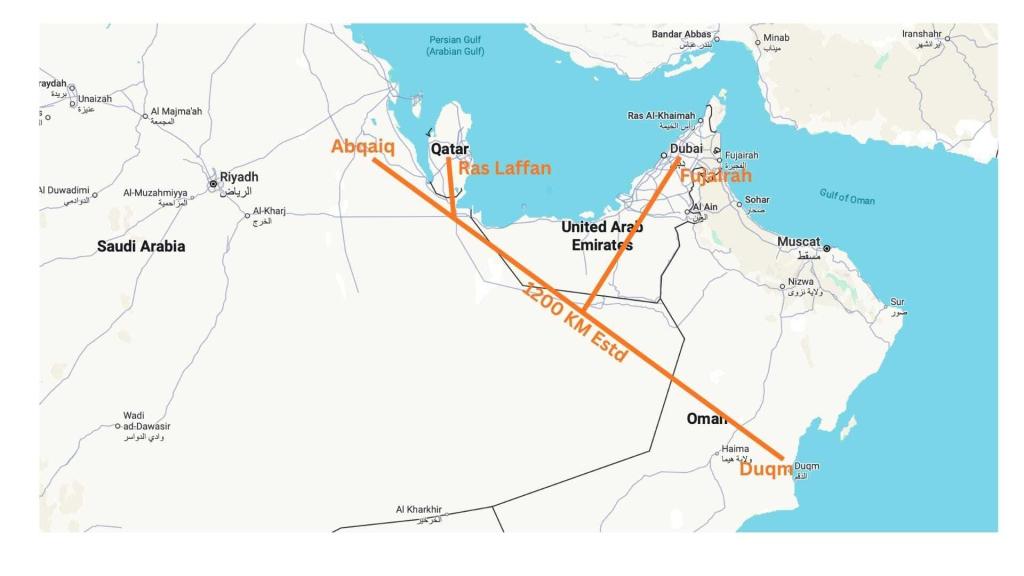
In recent months, the vulnerability of global energy supply chains has once again come into sharp focus. The instability surrounding the Strait of Hormuz is not a new concern—but the absence of a credible, actionable alternative remains a critical gap in global energy security.
While international institutions continue to deliberate, and geopolitical tensions constrain coordinated action, a fundamental question emerges:
What if the solution is not global—but regional, strategic, and interest-driven?
A Corridor Built on Alignment, Not Assumptions
The concept of the Arabian Energy Corridor offers a structurally different approach.
Rather than relying on external security guarantees, it is grounded in aligned economic interests among key stakeholders.
With potential participation from energy producers and major Asian consumers—including Saudi Arabia, China, and Japan—the corridor benefits from inherent strategic convergence:
Energy exporters seek reliable and diversified routes
Import-dependent economies demand long-term supply stability
Regional actors aim to reduce exposure to maritime chokepoints
This alignment creates a self-reinforcing framework for stability, where disruption is economically irrational for all major participants.
Reframing Regional Risk Dynamics
A critical aspect often overlooked in conventional discourse is the role of regional actors traditionally viewed through a security lens.
However, when assessed through an economic prism, the corridor aligns with the broader trade and energy interests of key neighboring economies, including South and East Asia. This alignment reduces incentives for disruption and gradually transforms risk into interdependence.
In this sense, infrastructure becomes not just a conduit for energy—but a
mechanism for de-escalation.
Beyond Traditional Multilateralism
Recent global events have exposed the limitations of existing multilateral frameworks in addressing urgent, high-stakes disruptions. Whether in energy security or conflict mediation, institutional responses have often lagged behind realities on the ground.
This raises an important strategic insight:
Functional economic alliances, built on shared interests, may prove more effective than formal global structures in times of crisis.
The Arabian Energy Corridor is not merely an infrastructure project—it represents a shift toward pragmatic, outcome-oriented regionalism.
Feasibility: From Concept to
Execution
Unlike many large-scale proposals that remain confined to theory, the corridor benefits from favorable physical and economic conditions:
Manageable terrain and engineering feasibility
Limited disruption to major urban centers
Controlled environmental exposure
Strong underlying demand fundamentals
These factors collectively enhance the practical viability of the project, positioning it beyond conceptual ambition.
A New Economic Geography: Oman at the Center
At the heart of this vision lies Oman—strategically positioned to transform into a regional energy, logistics, and industrial
hub.
The development of Duqm and associated infrastructure could unlock:
Significant foreign direct investment inflows
Technology transfer and industrial diversification
Expansion of logistics and energy storage capabilities
More importantly, this opens the door to long-term ecosystem development, including academic and research partnerships that can anchor sustainable growth.
Spillover Effects: Stability Through Shared Interests
While not a primary objective, the corridor introduces an important secondary dynamic:
Economic interdependence among
participating countries has the potential to foster greater regional stability.
In regions marked by historical tensions, shared infrastructure and mutual economic benefits can gradually reshape incentives—encouraging cooperation over confrontation.
A Timely and Practical Alternative
As global discourse increasingly turns toward “alternatives,” many proposals remain either politically constrained or operationally unrealistic.
The Arabian Energy Corridor stands apart because it is:
Regionally owned
Economically aligned
Geographically feasible
Strategically timed
It does not attempt to replace the global
system—but rather to complement it where it falls short.
Final Thought
In an era defined by uncertainty, resilience will not come from ideal frameworks—but from practical, interest-driven solutions.
The Arabian Energy Corridor is one such proposition—grounded not in theory, but in strategic necessity and economic logic.